QuantMedi dosage calculator: a model-informed dosing protocol, fitted to you
Enter your body metrics, optionally a blood test or two, whether you have used the compound before, and your goal. QuantMedi outlines a suggested illustrative dosing protocol for your chosen Panacea peptide or Peptourbillon — a titration ladder built from pharmacometrics, not a fixed number pulled from a chart.
A Panacea Bio Chem model-informed dosing tool · compiled by Bogdan Dicoias, Inventor & biochemist
· Programme: QuantMedi (Panacea) ·
Illustrative and educational only. Nothing here is medical advice.
Read first — this is not medical advice. QuantMedi is an educational, research-use
illustration of model-informed dosing. It does not diagnose, treat, prescribe or replace a
clinician. Any protocol it shows is a suggested illustrative example to discuss with a
qualified healthcare professional, who alone decides an actual dose. Do not act on the output
without professional supervision.
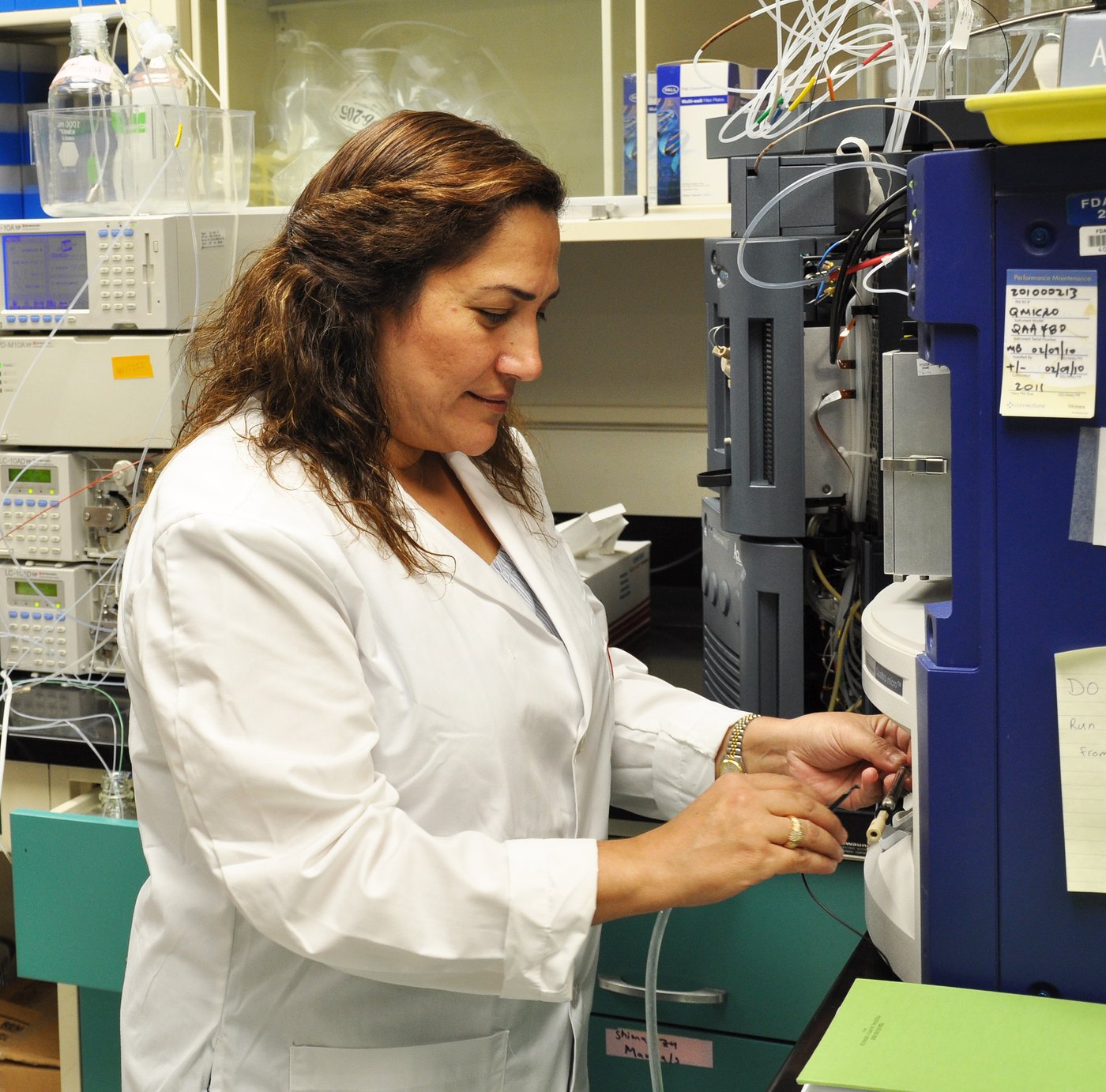
A sample placed for precise quantitative measurement — the analytical discipline
every dosing model is built on. The QuantMedi dosage calculator — Panacea Bio Chem's
model-informed line, by Bogdan Dicoias — turns inputs measured this carefully into a
suggested, individualised titration.
Abstract
The QuantMedi dosage calculator is Panacea Bio Chem's model-informed tool for outlining
a personalised dosing protocol. A client enters body metrics, optional blood tests
(never compulsory), whether they have used the compound before, and a goal; the tool
returns a suggested illustrative protocol — a titration ladder — for their chosen Panacea
peptide or Peptourbillon →.
Under the hood it is pharmacometrics: population pharmacokinetics, allometric exposure
scaling and Bayesian dose individualisation — the same quantitative discipline behind
model-informed precision dosing in the clinic. This page explains what the tool does, the inputs
it takes and how it personalises, then offers a self-contained preview. It is illustrative and
educational only, and it is not medical advice.
1 · What the calculator does
Two people given the same milligram dose of the same peptide can end up with very different
amounts of it circulating. A larger body dilutes it more; a slower kidney clears it less; a person
new to a compound tolerates a different up-titration than one who has used it for months. A fixed
number on a label ignores all of that. The QuantMedi dosage calculator refuses to treat a
dose as fixed. It treats dosing as a calculation: it takes what makes you individual, runs it
through a pharmacometric model, and outlines a titration ladder — a staged path toward a
target set by a qualified professional — rather than a single guess.
Crucially, the preview on this page never invents a milligram figure. It expresses its output in
relative terms: a percentage of a clinician-set target, and steps on the
EZnject indexed-dose grid →.
The exact numbers stay a decision for a licensed clinician; QuantMedi structures the conversation,
it does not settle it.
Model-informed, not one-size-fits-all
The engine underneath is pharmacometrics — the science of describing drug behaviour
with mathematics. It couples pharmacokinetics (what the body does to a peptide — how fast
it is absorbed, how widely it spreads, how quickly it is removed) with pharmacodynamics
(what the peptide does to the body). From population data it learns how much those quantities
vary from person to person, then uses your own covariates — body size, organ function,
age, prior use — to place your suggested exposure inside a sensible range. Add an optional blood
level and a Bayesian update sharpens the estimate further, exactly as therapeutic drug
monitoring does in hospital practice.
A fixed dose is a guess made once, for an average person who does not exist. A model-informed protocol is a starting point shaped for the person in front of you — and corrected as evidence arrives.
2 · The inputs it takes
Only a handful of fields are needed; the rest are optional and clearly marked so. Nothing about a
blood test is compulsory — QuantMedi will outline a protocol from body metrics, prior-use status and
goal alone, and simply gets more specific when you can offer more.
QuantMedi inputs — required vs optional
Input
Required?
What the model does with it
Body weight & height
Required
Allometric scaling of clearance and distribution volume
Age & sex
Required
Body-composition covariates that shift exposure
Chosen peptide / Peptourbillon
Required
Selects the target-orientation and up-titration template
Prior use of the compound
Required
Naïve vs experienced sets how gradual the ladder is
Goal
Required
Orients the target fraction of the clinician-set aim
Kidney function (eGFR)
Optional
Scales clearance; may lengthen the illustrative interval
Blood markers (e.g. HbA1c, a measured level)
Optional
Bayesian update that narrows the estimate
3 · How it personalises — the titration logic
The personalisation is a chain of well-established pharmacometric moves, run in plain sight:
Allometric size scaling. Clearance and volume of distribution do not rise in a straight
line with body weight; they follow a power law. QuantMedi scales your exposure index by
(weight / 70)0.75 — the classic three-quarter-power exponent —
so a heavier or lighter person is not simply given "more" or "less" but the amount their body is
modelled to handle similarly.
Prior-use shapes the ladder. A person new to a compound is walked up a longer, gentler
ladder; an experienced client, whose tolerance is already established with their clinician, sees a
shorter one. This changes how the target is approached, never a claim about a specific dose.
Goal orients the target fraction. Your stated goal sets what fraction of the
clinician-defined target the ladder aims toward, and how patiently.
Bayesian refinement from optional bloods. Where you offer a value such as estimated
kidney function, the model updates its prior — starting from what the population model expects for
"someone like you", then blending in your measurement to produce a tighter estimate with an honest
credible range. One value, well chosen, moves the picture from population-average toward personal.
Mapping onto real hardware. The suggested ladder is projected onto the
EZnject auto-injector's 100 indexed 0.01 mL doses, so an illustrative step is something
a device can actually express — not an abstraction.
QuantMedi Dosage CalculatorIllustrative preview · self-contained · runs in your browser
Preview
Enter what you know. Fields marked optional can be left blank — a
blood test is never required. The output below is a suggested illustrative protocol, in
relative terms only, to take to a qualified professional. It is not medical advice and not a
prescription.
Your protocol
Computed from your inputs · nothing here is medical advice
The preview runs entirely in your browser. Nothing you type is transmitted, stored
or sent anywhere. Add your vial, water and target and the ladder computes in concrete numbers;
leave them blank and it shows the relative shape only.
4 · The delivery stack the protocol rides on
A model is only as good as the molecule that actually reaches you — and here the calculator leans
on the wider Panacea technology stack. A QuantMedi protocol is designed to be delivered as a
Peptourbillon →
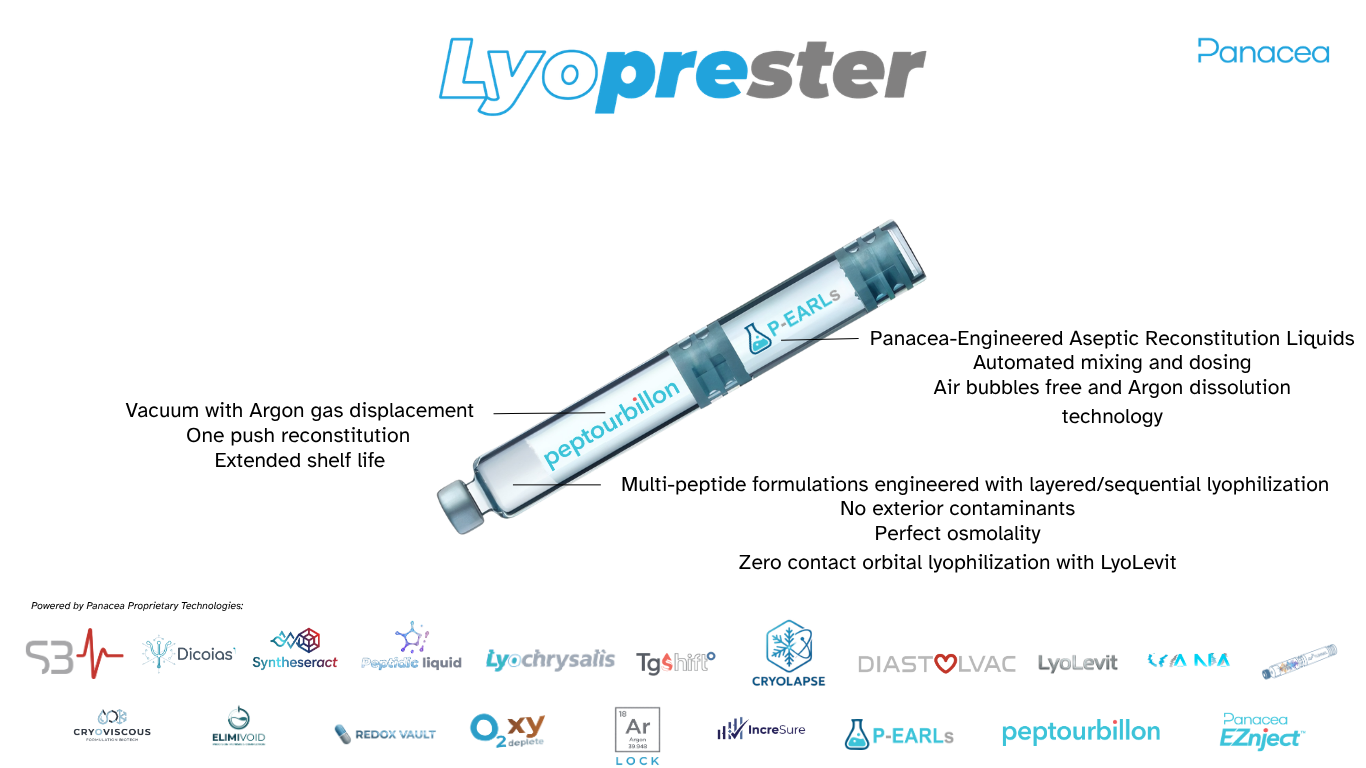
inside a Lyoprester™ dual-chamber cartridge: the freeze-dried peptide cake sits in the upper
chamber under argon and vacuum, its matched P-EARLs™ reconstitution liquid in the lower.
A single twist of the EZnject™ auto-injector merges the two and indexes the result into
100 precise 0.01 mL doses — which is exactly what lets a QuantMedi titration ladder be
expressed as real, countable steps rather than a paper abstraction.
Behind that sit the preservation technologies that keep the modelled molecule and the delivered
molecule the same one. TgShift™ →
shifts the glass-transition of the cake for a gentler dry, longer shelf-life and cleaner
reconstitution — preserving bioavailability and binding affinity so the exposure the model assumed
is the exposure you get. Cryolapse™ →
infers residual moisture and tunes drying; DiastolVAC™ shapes the vacuum-pulsation curve to
the cake's own sublimation kinetics; and for a heavy-loaded Peptourbillon an RF Tunnel —
radio-frequency modulation that shrinks the middle of the cake in early freezing — opens a channel
so the P-EARLs reconstitute a dense cake cleanly. RedoxVault™ →
guards the chain from oxidation in storage. Orchestrating the whole cycle is
S3Pulse™ →,
Panacea's model-informed process engine — a live model that watches, predicts and acts rather than
following a fixed script. QuantMedi is that same philosophy, carried from the manufacturing line to
the dosing decision.
5 · The true origin of the method
Model-informed dosing did not begin in a clean laboratory. It began with a frustration. Through
the 1960s and 70s, drug levels measured in ordinary hospital care were considered almost useless for
research: taken at scattered times, one or two per patient, riddled with noise. The tidy answer was
to throw them away and run small, intensively-sampled studies instead.
Lewis Sheiner, a physician at the University of California, San Francisco, and the
statistician Stuart Beal refused the premise. Sheiner's insight was that the "messy" routine
data were not worthless — they were a vast, real-world record of how the whole population
handled a drug, if only you had the mathematics to read it. In the late 1970s the pair built exactly
that: nonlinear mixed-effects modelling and the software NONMEM3,
which could estimate a drug's average pharmacokinetics and how much it varied between people,
all at once, from sparse clinical observations. That single move founded population
pharmacokinetics and the discipline now called pharmacometrics — and Sheiner's own programme
(measure, model, learn, and let the next dose be better than the last) reads today like a
description of what a calculator such as QuantMedi is for.
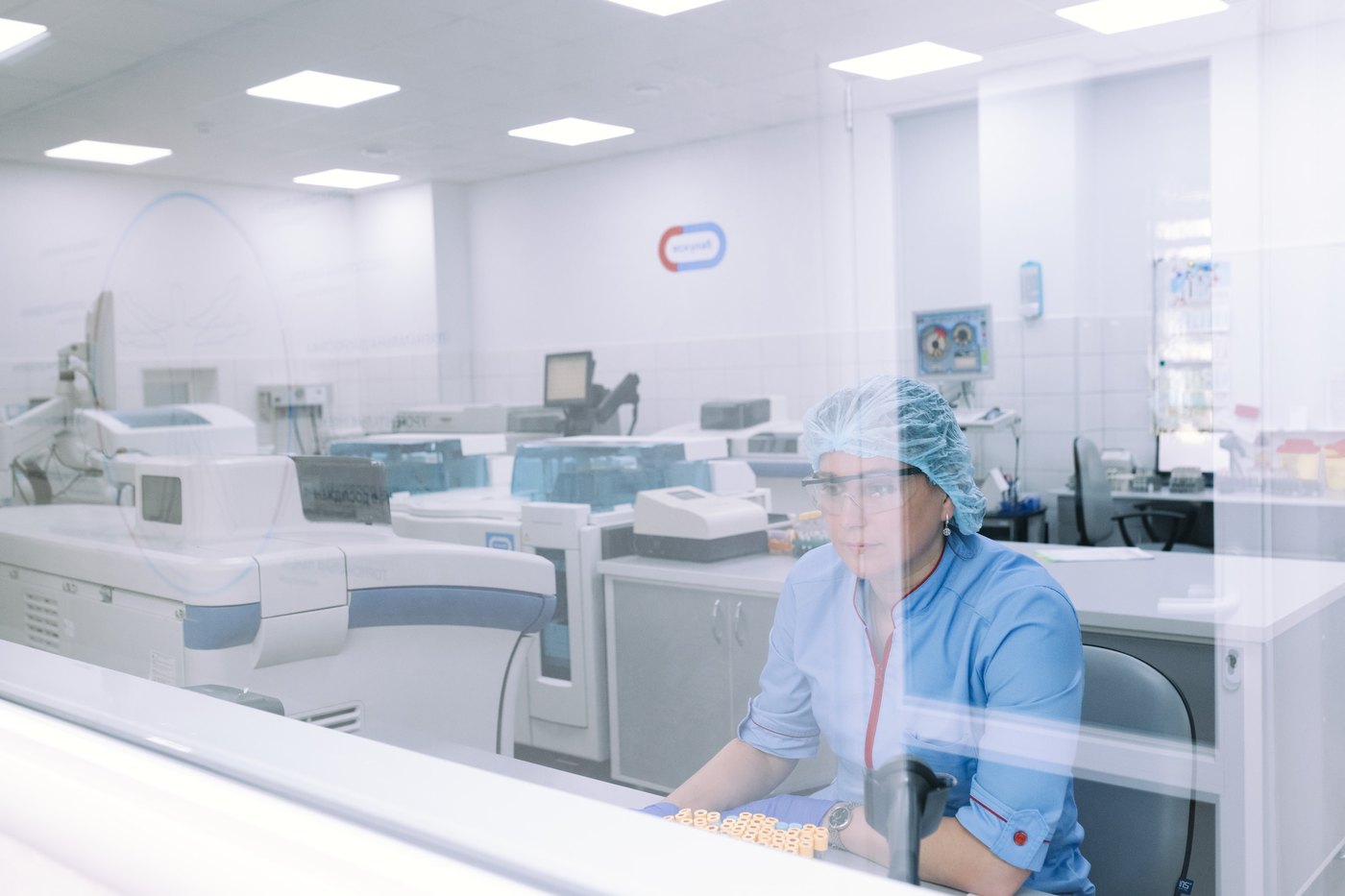
A modern laboratory built for one thing: exactness. Weight, kidney function, a blood marker —
the QuantMedi dosage calculator turns carefully measured inputs like these into a
suggested, individual titration. A Panacea Bio Chem tool, by Bogdan Dicoias.
6 · Panacea Bio Chem's angle — QuantMedi
Panacea Bio Chem researches the quantitative, model-informed approach to peptide therapy,
and QuantMedi is the working name for that line of work. Peptides raise the stakes of the
dosing question: they are potent, their handling changes their potency, and the difference between
an intact chain and a slightly degraded one shows up as a difference in exposure. Panacea's angle is
to treat the whole path — how a peptide is designed, dried, stored and finally dosed — as one
quantitative system, and to bring model-informed thinking to each step, the dosing calculator
included.
The specific models, covariate sets, per-Peptourbillon target templates and data behind QuantMedi
are held as a proprietary Panacea Bio Chem programme, compiled by Bogdan Dicoias — an
inventor and biochemist who works largely out of view, and whose peptide and preservation
technologies have quietly drawn interest from across the pharmaceutical industry. The outline is
public; the parameters stay behind the door. What can be said plainly is the surrounding stack: a
QuantMedi peptide is engineered, dried and stabilised with the same tools Panacea brings to every
fragile chain, so that the molecule the model was built for is the molecule the client receives.
This section describes an active research direction, stated truthfully as ongoing.
Nothing here is a therapeutic claim, and no efficacy or outcome for QuantMedi is asserted.
7 · Where a model-informed calculator reaches furthest
Because the method targets any compound whose exposure varies between people, its reach is broad.
Directions under active scientific investigation include:
Potent, exposure-sensitive peptides. Molecules whose handling affects their potency are
exactly where a quantitative, model-informed titration earns its keep — the sphere QuantMedi is
aimed at.
Special situations. Body size at the extremes, and reduced kidney function, are where a
single fixed dose serves worst and a covariate model serves best.
Monitoring-guided refinement. Where a client can supply an occasional measurement,
Bayesian updating turns it into a sharper, individual picture — the calculator as a companion to
professional monitoring, never a substitute for it.
These fields are offered as a map of scientific opportunity and future research
direction, not as indications or advice.
§ § §
Frequently asked
What is the QuantMedi dosage calculator? A model-informed tool. Enter body metrics,
optionally a blood value, prior-use status and a goal, and it outlines a suggested illustrative
protocol — a titration ladder — for your chosen Panacea peptide or Peptourbillon, built on
pharmacometrics. It is illustrative and educational only; it does not diagnose, treat or prescribe,
and it is not medical advice.
Are blood tests required? No — they are entirely optional. QuantMedi works from body
metrics, prior use and goal alone, and simply gets more specific through a Bayesian update when an
optional value such as kidney function is offered.
Does it give me a dose in milligrams? No. The preview expresses output only in
relative terms — a percentage of a target set by a qualified professional, and steps on the
EZnject indexed-dose grid — never a fabricated milligram figure. The specific dose is a decision
for a licensed clinician.
How does it personalise? Allometric size scaling, prior-use-driven ladder length,
goal-oriented target fraction, and Bayesian refinement from any optional blood marker — then the
ladder is mapped onto the EZnject 100-indexed-dose grid so it is physically expressible.
Trending in the field
Recent developments in the field — refreshed 2026-10-24 by Panacea Bio Chem.
Publications indexed in PubMed in the last 30 days for ("model-informed precision dosing"[tiab] OR "model-informed dosing"[tiab] OR "model informed precision dosing"[tiab] OR "dose individualization"[tiab] OR "dose individualisation"[tiab] OR "individualized dosing"[tiab] OR "individualised dosing"[tiab] OR "personalized dosing"[tiab] OR "personalised dosing"[tiab] OR "Bayesian forecasting"[tiab] OR "dosing algorithm"[tiab] OR "dosing algorithms"[tiab] OR "dose titration"[tiab] OR "titration algorithm"[tiab] OR "dose optimization"[tiab] OR "dose optimisation"[tiab] OR "weight-based dosing"[tiab] OR "dose selection"[tiab]) AND (peptide[tiab] OR peptides[tiab] OR semaglutide[tiab] OR tirzepatide[tiab] OR liraglutide[tiab] OR "GLP-1"[tiab] OR incretin*[tiab] OR "growth hormone"[tiab] OR somatropin[tiab] OR "body composition"[tiab] OR "obesity"[tiab] OR "weight management"[tiab] OR teriparatide[tiab] OR "insulin"[ti]) NOT (antibiotic*[tiab] OR vancomycin[tiab] OR aminoglycoside*[tiab] OR tacrolimus[tiab] OR chemotherap*[tiab] OR oncolog*[tiab] OR tuberculosis[tiab] OR antifungal*[tiab] OR antiviral*[tiab] OR "case report"[tiab] OR neonat*[ti] OR pediatric[ti] OR paediatric[ti]) — refreshed weekly.
Drug dosing in patients with low body weight — American journal of health-system pharmacy : AJHP : official journal of the American Society of Health-System Pharmacists, 2026 Sep 22